
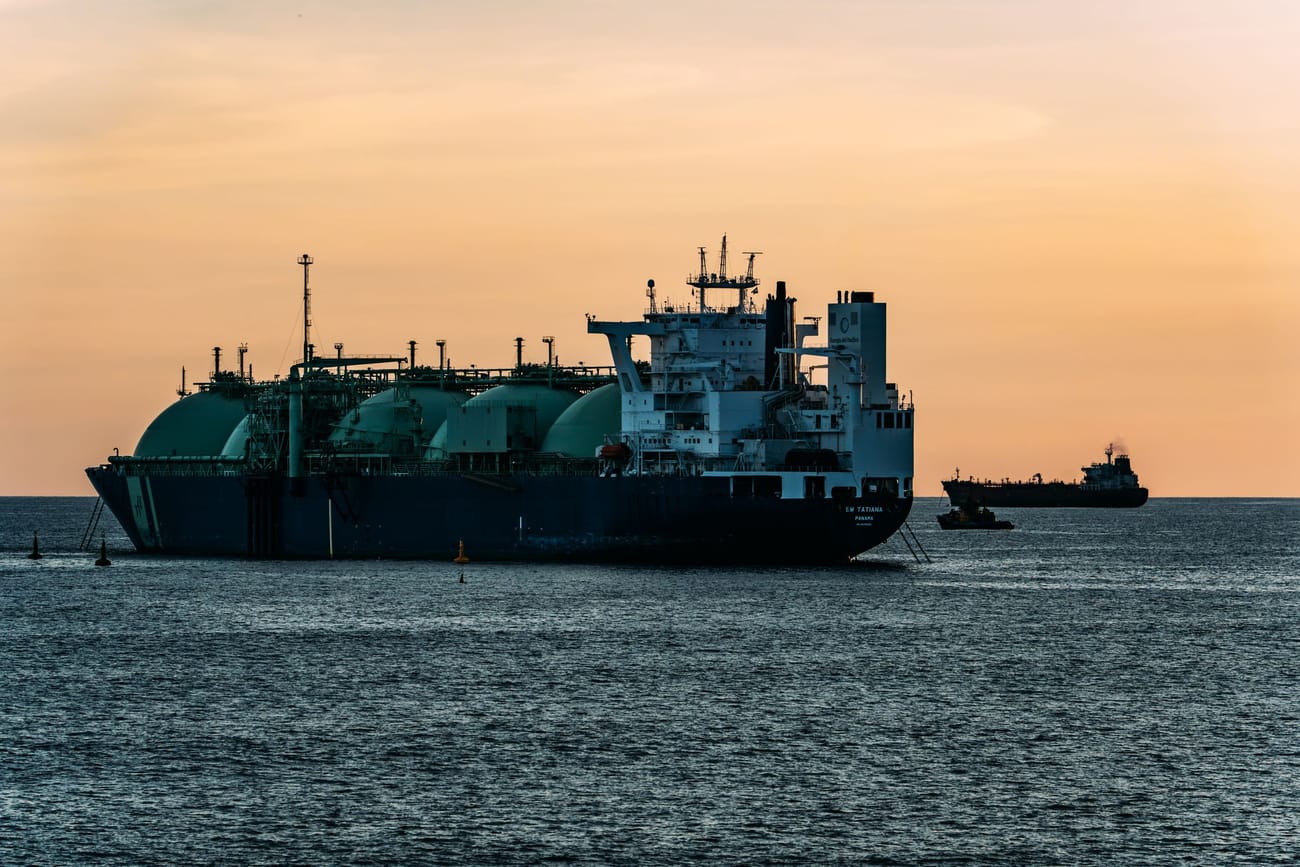

The Kestrel Aurora left a gas terminal in Western Australia with 138,000 cubic metres of liquefied natural gas in four spherical tanks. Twelve days later, when her manifold was coupled to the shore arms in Tokyo Bay, she delivered a little over 135,500. Nobody stole the difference and none of it went over the side. The ship burned it.
That missing 1.8 per cent is one of the oldest arrangements in the gas trade and one of the least understood outside it. An LNG carrier is a vacuum flask the size of a stadium, and no flask is perfect. The cargo warms, a sliver of it boils, and the ship feeds the vapour to its own engines. What owners now argue about is how much of that sliver they can afford to keep.
Heat always wins
LNG is methane cooled to about minus 162°C, the point at which it turns liquid at roughly atmospheric pressure. In that state it takes up about one six-hundredth of the space it would fill as a gas. But the tanks sit in an ocean at 25°C under a deck that reaches 50°C in the afternoon sun. Heat finds its way in through the insulation, the supports and the pipework, however good they are.
The cargo cannot get warmer without changing state, so it boils instead. Engineers call the result boil-off gas and measure it as a share of the cargo per day. On older ships with spherical Moss tanks, 0.15 per cent a day is normal. Newer membrane designs claim 0.085 per cent or less.
Fuel that was already aboard
Boil-off cannot simply stay in the tanks. Pressure would climb until the relief valves lifted. For decades the tidy answer was to burn it, and steam-turbine carriers like the Kestrel Aurora, built twenty years ago, still send the vapour straight to their boilers and top up with fuel oil when the gas runs short.
The cargo is always trying to leave. My job is to decide where it goes.
Anneli Vuorinen has been chief engineer of the Aurora for six years. At full speed, she said, the boilers want more gas than the tanks make. At slow steaming the balance flips. "Then we have more gas than the boilers can use, and it goes to the gas combustion unit. That is a polite name for a flare in a box."
The arithmetic of a voyage
On the Aurora, 0.15 per cent a day works out at about 207 cubic metres of liquid, or roughly 93 tonnes of LNG every 24 hours. Over a twelve-day laden passage that is close to 2,500 cubic metres. At $11 per million British thermal units, the delivered price used by the Break Freight Index desk for this piece, the gas the ship consumed on one voyage was worth about $640,000.
The charter party decides who carries that cost. Most long-term charters set a guaranteed maximum boil-off rate. The charterer owns the cargo and accepts that the ship will burn some of it; above the guarantee, the owner pays for every extra cubic metre.
Keeping the tanks cold
The empty leg has its own rules. A carrier returning to load keeps a heel, usually 1,500 to 3,000 cubic metres of LNG left in the tanks, so the steel stays cold. A tank allowed to warm must be cooled down again before it can take cargo, which costs a day at the berth and several hundred cubic metres of gas sprayed through the tank to chill it.
Re-liquefaction comes aboard
Newer ships have changed the sum. Dual-fuel two-stroke engines are so efficient that at slow speed they burn less gas than the tanks produce. Rather than flare the surplus, owners are fitting re-liquefaction plants: compact refrigeration units that cool the vapour back to liquid and pump it into the tanks again.
Kestrel Gas Shipping, which operates the Aurora and nine other carriers, has ordered two retrofits from Fjordline Cryogenics for its membrane ships, at about $12 million each. Marcus Deland, the company's technical director, said the plants draw 2–3 megawatts of electricity when running hard. "We are spending fuel to save cargo," he said. "It pays when the gas is expensive and the voyage is slow. When gas is cheap, the plant is a very well-engineered box of spare parts."
Who pays for the missing gas
At the discharge terminal, surveyors measure the tank levels, temperature and gas composition before and after the transfer, and the buyer pays for the energy that crosses the manifold, not for what left Australia. That custody-transfer figure is the one every trader on the energy desk watches, and the one that makes a better tank worth money.
The Kestrel Aurora is due in drydock in the spring. There is no re-liquefaction plant on the work list; the ship is too old to justify one. "She will burn what she makes until the end," Ms Vuorinen said. "Steam ships were built for that."





Discussion