
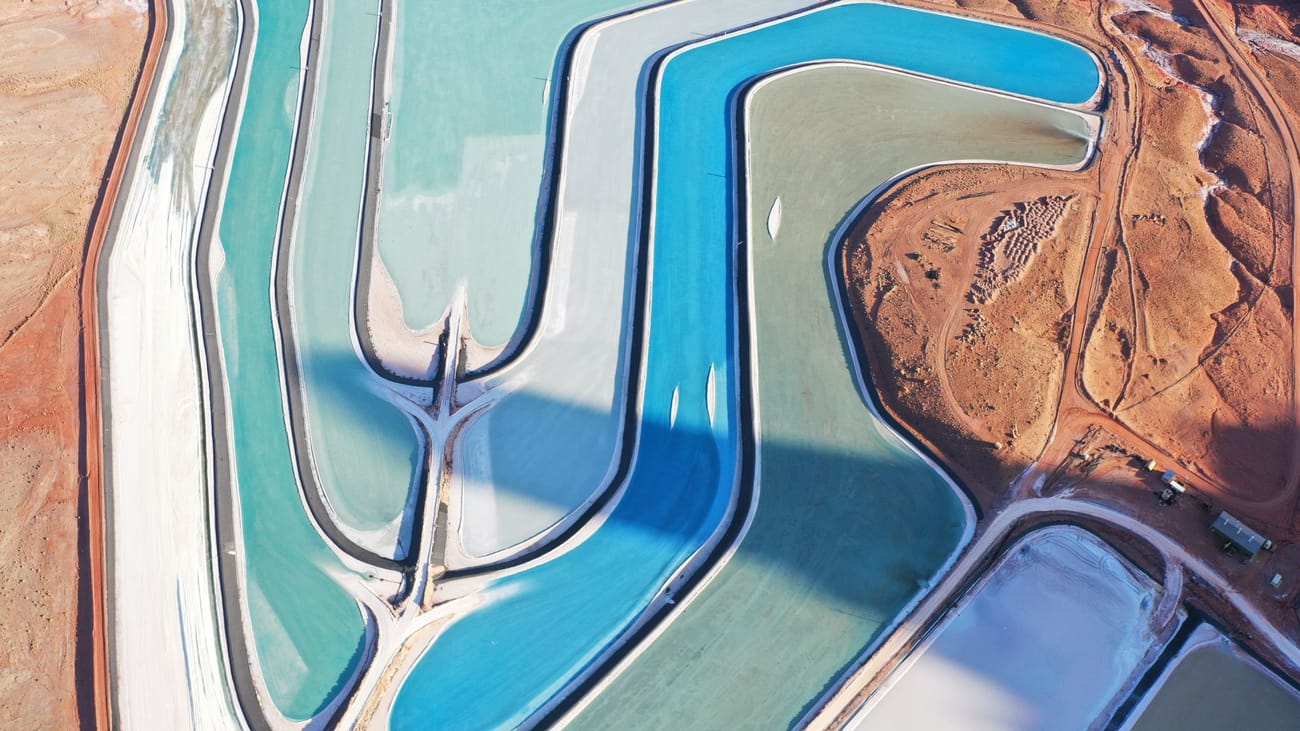

The first pond at Salar de Ancoya is the blue of a hotel swimming pool and nearly the size of a small airfield. Brine pumped from forty metres beneath the salt crust spreads across it a few centimetres deep, and the sun, which at 2,300 metres has little air to pass through, begins the work that Andaluna Lithium's accountants measure in months. By the ninth pond the liquid is the yellow of weak tea. By the last it is thick, faintly oily and worth a great deal of money.
Over the past year I returned to the salt flat four times, in the southern winter and the southern summer, at harvest and at the bottom of a price cycle that has turned the white powder at the end of this process into one of the most argued-over materials in the energy transition. This is what the ponds, and the people who live beside them, showed me.
How the ponds work
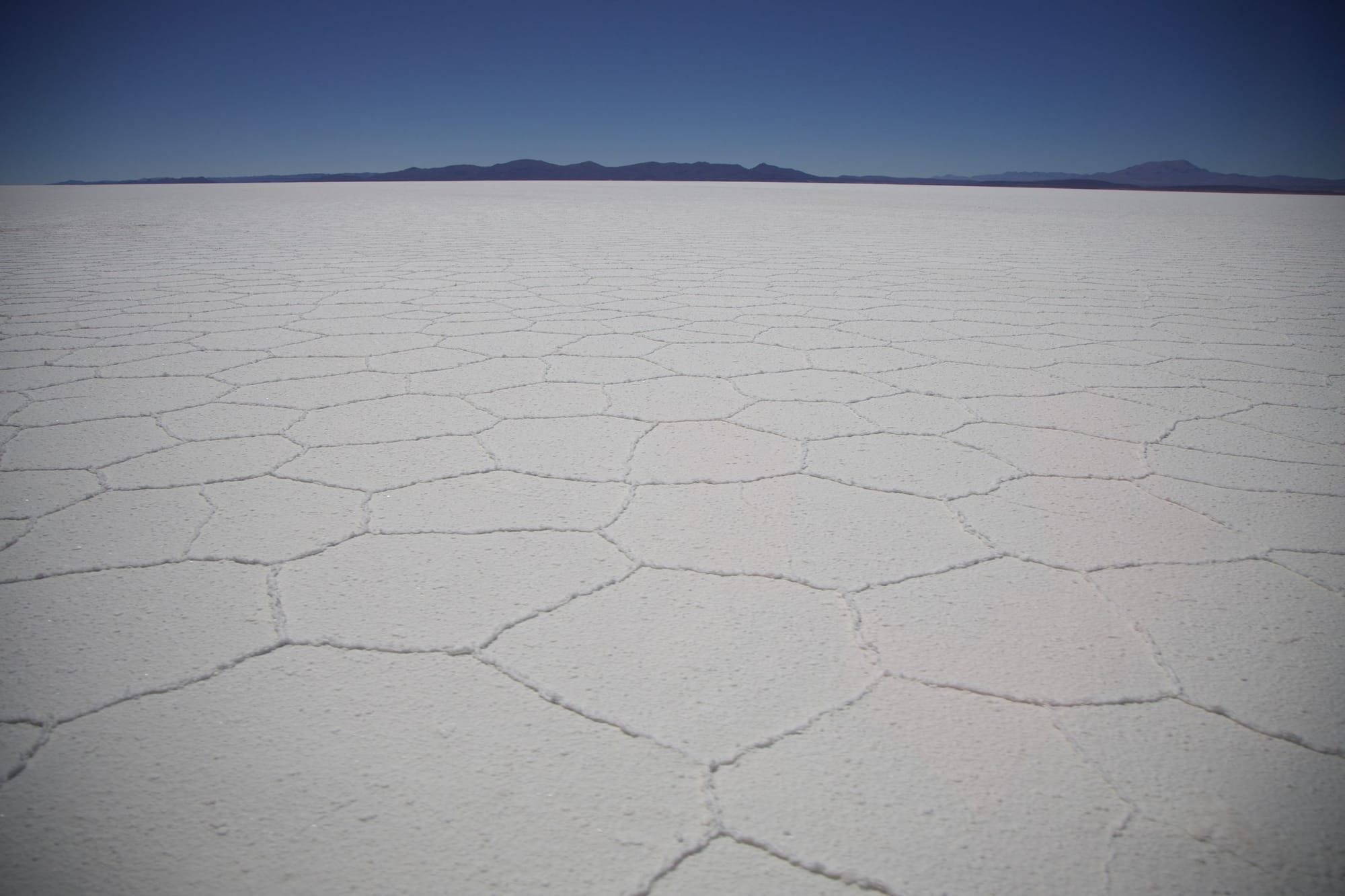
Andaluna holds a concession over 280 square kilometres of the salar's southern lobe, a flat white plain in the high Andes of northern Chile ringed by volcanoes that still carry snow in the winter. Twenty-one wells draw brine that holds about 0.16 per cent lithium, roughly one and a half kilograms of the metal in every tonne of liquid. The rest is mostly sodium, potassium, magnesium and chloride, plus a trace of boron that the chemists downstream would rather not see.
Eighteen months of sun
The brine moves by gravity and small pumps through a chain of fourteen ponds. Each one is lined with black plastic sheeting under a layer of compacted salt, and each holds the liquid for weeks until evaporation has pushed the concentration high enough to send it on. The whole journey takes between 14 and 18 months, depending on wind and cloud. A wet summer, which happens more often than the company's early plans assumed, adds two months.
"The sun is the cheapest energy we buy, and the only supplier we cannot call," said Valentina Ruiz, the pond operations manager, standing on a berm in a wind that made her shout. She has worked at the salar for eleven years and keeps a notebook of evaporation rates in pencil, because ink freezes on the winter morning rounds.
What the salt leaves behind
As the water goes, the other salts fall out. Common salt crystallises first and is scraped off by front loaders and piled in white ridges beside the ponds. Potassium salts follow and are sold as fertiliser feedstock, a by-product that covered a third of the site's operating costs last year. What reaches the final pond is a concentrate of about six per cent lithium. Tanker trucks carry it 260 kilometres down to a chemical plant near the coast, where it becomes lithium carbonate, a powder fine enough to leave prints on a black glove.
The water question
Llancura, the nearest village, sits 30 kilometres north at the edge of the salar, where fresh water from the mountains meets the salt. Its 600 residents grow quinoa and alfalfa on terraces and keep llamas. Below the village is a shallow lagoon where flamingos feed on the brine shrimp. Andaluna says brine is not water in any sense that matters to Llancura. It is too salty to drink or irrigate, and it sits in a separate layer of the aquifer.
The village water committee does not accept that the layers are separate. It points to a lagoon that has shrunk in each of the last six dry seasons, and to a spring on the eastern shore that now runs only at night.
They tell us it is two different waters. Our grandparents only ever saw one.
That was Rosa Quispe, who chairs the committee and runs its monitoring programme from a laptop in the old schoolhouse.
Counting what goes out
Both sides now measure. Andaluna pumps about 400 litres of brine a second and 18 litres a second of fresh water from two wells for its plant and camp. Under an agreement signed two years ago, the company pays for twelve monitoring wells and the committee holds a key to every one of them. Quispe's readings and the company's have diverged by less than a centimetre on most wells. On two wells nearest the lagoon, they disagree by forty.
A price that fell off a cliff
When I first visited, lithium carbonate was changing hands at levels that made every pond on the salar look like a printing press. By my third visit it had lost roughly four fifths of its value, according to the assessments of Pardo & Vial, a Santiago commodities broker whose weekly note is read by most producers in the region. Battery makers had overbuilt their orders, new mines in several countries had arrived at once, and the buyers who had queued for tonnes now asked for discounts.
Brine producers sit near the bottom of the cost curve, which is why Andaluna is still pumping. Its chief financial officer, Álvaro Benítez, puts the site's cash cost at a little under $6,000 a tonne of carbonate, well below most hard-rock mines. That margin did not save the expansion. Six new ponds, already surveyed and pegged, were deferred in the autumn. The pegs are still there, with orange ribbons faded almost white.
The challenger in a shed
At the southern edge of the concession, behind a fence and a row of shipping containers, sits a prefabricated shed about the length of a tennis court. Inside is Andaluna's pilot for direct lithium extraction, the family of technologies that promises to do in hours what the ponds do in seasons.
Hours instead of seasons
Brine goes into steel columns packed with a sorbent that holds on to lithium and lets most of the other salts through. Fresh water washes the lithium off, and the spent brine, lighter by its lithium and little else, is pumped back underground through a reinjection well. Mateo Ibarra, the process engineer who runs the pilot, showed me a jar of the eluate: clear, slightly warm and already at a concentration the ponds need a year to reach.
The catch
The catch is in the inputs. The columns need fresh water to strip the lithium, which is the one thing Llancura is watching. They also need electricity, and the salar has no grid connection; the pilot runs on diesel generators that are refuelled by truck twice a week. Reinjection works in the shed's small test well. Nobody yet knows how it behaves at the scale of a commercial plant. "The chemistry is solved," Ibarra said. "The plumbing is the hard part, and plumbing is what we sell."
Buyers want paperwork
The change people at the ponds talk about most is paperwork. Hanseon Cathode, a Korean battery-materials maker that buys roughly a third of Andaluna's output, now asks for monthly water data, a list of every chemical reagent used on site and a signed chain-of-custody record for each tanker load. Its auditors visited twice last year and asked to meet the water committee without company staff in the room. Andaluna agreed.
Ji-woo Park, who manages raw-material sourcing for Hanseon, said the car makers the company supplies were passing their own questions down the chain. "Our customers ask us where the water came from," she said on a call from Seoul. "We need an answer that survives an audit, not a brochure."
Harvest at the last pond
On my last visit, at the end of the southern summer, the final pond was ready. A tanker backed up to a steel manifold at dusk, the driver in a face mask against the salt dust. The concentrate came up through a hose with a sound like a slow drain, and the truck sank visibly on its springs. Six more would follow before midnight, each one leaving for the coast with its lights on high beam across a road that sees perhaps a dozen vehicles a day.
The ponds nobody has filled
Before I left, Ruiz drove me to the deferred expansion. The six new ponds exist only as a grid of stakes and a single graded berm, the salt beneath it pressed smooth by a roller that has since been moved to another job. She stood on the berm and looked west toward the old ponds, blue to yellow in a line against the dark volcanoes.
"When the price comes back, the ponds will still take eighteen months," she said. "The shed might take eighteen hours. Somebody in an office will decide which one we build." Then she checked her pencil notebook, wrote down the evening's wind speed and drove back to camp.





Discussion