
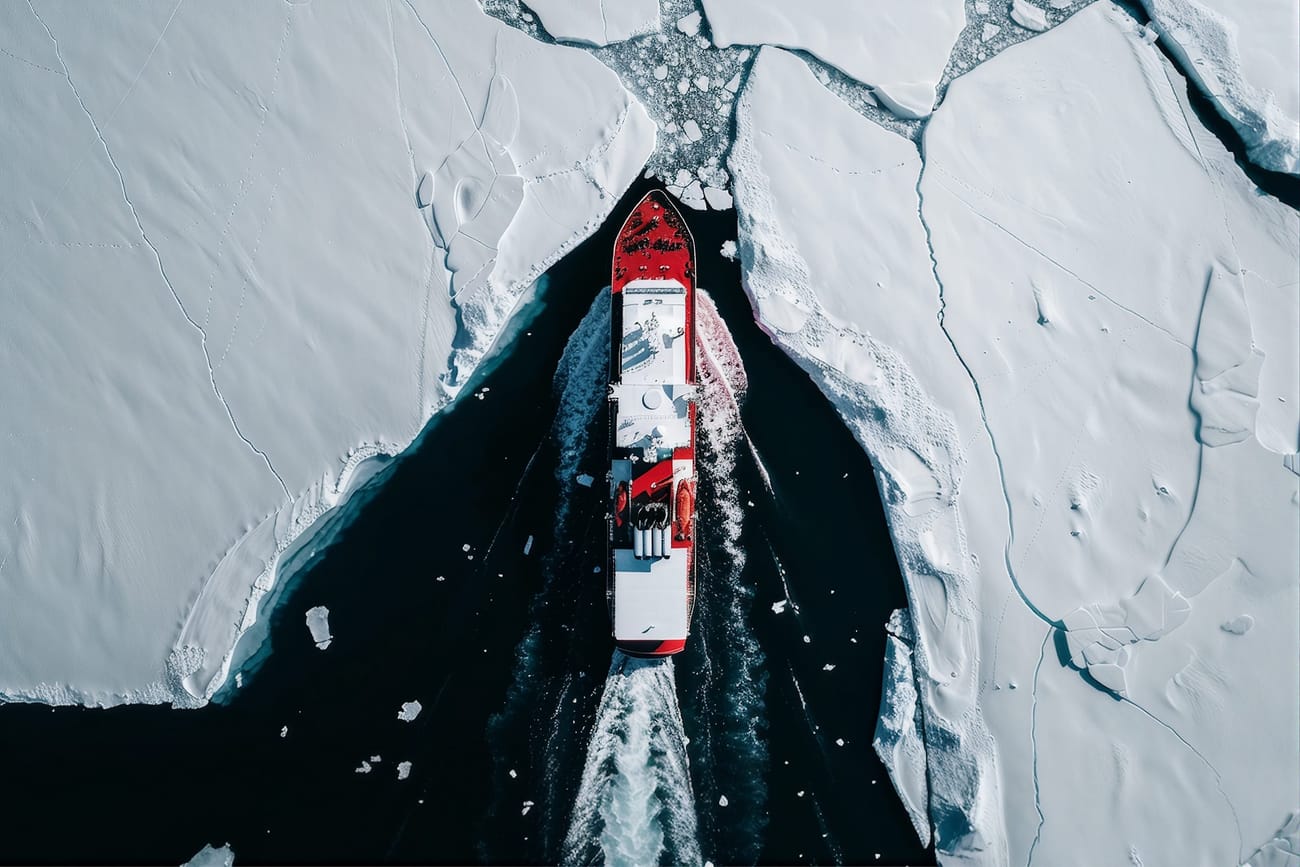

At seven this morning a 138-metre container feeder called Skarv was closing on the approach to Rotterdam with 614 boxes on deck and no one on her bridge. Nordvik Feeder Lines, the Bergen operator that owns her, says it is the first commercial crossing of the North Sea by a cargo ship steered from shore, and expects her alongside at the Maasvlakte feeder quay before nine.
She left the company's terminal at Brekkevik, at the head of a fjord north of Bergen, thirty-one hours earlier. For the whole passage she was steered by software and watched from a converted grain office in Rotterdam's Merwehaven, where I spent the night.
The room ashore
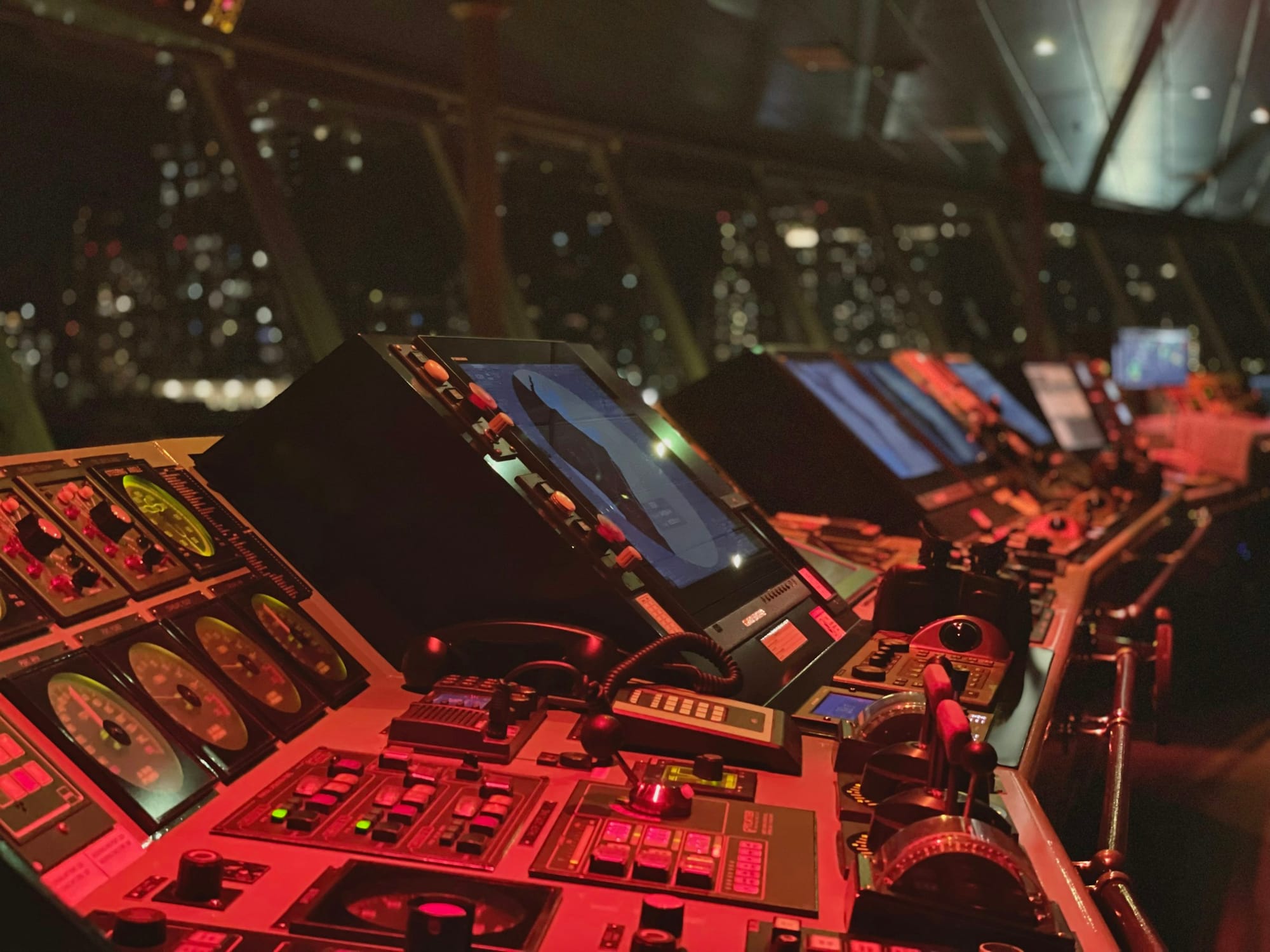
The control centre is smaller than a school classroom. Six desks face a wall of screens: radar overlays, a camera feed from each bridge wing, an engine-room schematic in green and amber, and an electronic chart with Skarv as a small black arrowhead. The windows carry blackout film so the screens stay readable at dawn. There is a kettle, a first-aid box and a red handset that rings straight through to the ship's satellite terminal.
Two people sit the watch at any time. One is the remote operator, a certified master mariner who can take the ship over by hand. The other watches the machinery. They change every four hours, as they would at sea, and the handover is spoken aloud and recorded.
"You lose the motion, which you miss, and you lose the smell of the engine, which you don't," said Ingrid Solberg, 44, who spent nineteen years on tankers and chemical carriers before she took the operator's chair. "On a bridge you turn your head to see things. Here you just look up."
What the permit asks for
International rules for autonomous merchant ships are still being written, so for now every voyage like this one rests on permission granted case by case. Nordvik's approval, issued by the ship's flag administration together with the coastal states along her route, runs to forty-two pages. The company shared a summary with Break.
- A qualified master must be in control ashore at all times, with a second person on watch beside them.
- Two engineers must be aboard and able to reach the bridge within ten minutes.
- The ship must stop and hold her position on her own if the link to shore drops for more than ninety seconds.
- Every harbour approach is handled by a licensed pilot, who boards as on any other ship.
That last condition means Skarv is autonomous in open water and conventional in port. "People hear 'crewless' and picture a ghost ship sailing into the Maasvlakte on her own," said Arne Vatne, Nordvik's operations director. "The pilot boards off the Maas like on every other feeder. The difference is the thirty hours before that."
Three in the morning
The crossing was uneventful until 02:58, when Skarv was about sixty nautical miles north-west of Den Helder. Her radar picked up eleven small targets spread across four miles of her track: a fishing fleet working the bottom with beam trawls, most of the boats turning slowly and at angles no software could predict.
Collision-avoidance systems handle ships that behave like ships. Trawlers with their gear down do not. They zigzag at three knots, stop dead and turn across the bow. Skarv's system slowed her to eight knots and proposed an alteration to starboard, then a second one. At 03:04, after the third revision in four minutes, Solberg took manual control.
For the next forty minutes she steered by joystick and by voice, calling two of the skippers on VHF from Rotterdam. One of them, she said, asked twice where on the ship she was standing. She did not tell him. At 03:47 she handed the ship back to the software on a clear track, eleven minutes behind schedule.
The software was right every time. It was just right too slowly, and a fishing fleet will not wait for you to finish thinking.
Ingrid Solberg, an hour after she handed the ship back, over a cup of tea that had gone cold.
Nordvik logged the episode as a planned intervention, which its permit allows. Vatne said the trawler problem was the one his engineers had expected to lose sleep over. "We trained the system on four years of North Sea traffic, and fishing boats are still the hardest thing out there. The logs go to the flag administration this week."
The last miles in
By six the wind had backed south-westerly and the swell had eased. The ship's two engineers, who spend the voyage in cabins behind the funnel, came up at first light to check the lashings on the forward bays, as the permit requires. Their names were withheld at the company's request.
A pilot was due aboard by ladder shortly after half past seven. From then on the ship is being run the way every feeder entering the port is run: a pilot on the bridge giving orders, and in this case an operator ashore carrying them out. We will update this story when Skarv is made fast.
What it means for crews
A conventional feeder of this size carries eleven to thirteen people. Nordvik says its model needs six people ashore per ship, spread across the watch rota, plus the two engineers. It is hiring its operators from its own fleet and says no one has been made redundant.
Seafarers' representatives are not reassured. "Six jobs ashore replacing twelve at sea is still six jobs gone," said Kari Mjelde, secretary of the Nordic Seafarers' Forum, a regional officers' association. "And it takes the cadet berth away. Where does the next Ingrid Solberg learn her trade if there is no bridge to learn it on?"
The industry has no answer to that yet. Every remote operator working today is a former seafarer, and Nordvik's own training plan assumes a supply of officers with sea time that ships like Skarv no longer create. Vatne concedes the point. "We will keep crewed ships in the fleet for a long time. Some of that is for training. Some of it is because the rules will take longer than the software."
What comes next
Nordvik plans twelve round trips on the Brekkevik–Rotterdam loop before the end of the year, then a second ship on a run to Hamburg. Two other North Sea operators have applied for similar permits, according to people familiar with the applications. Insurers are reading the logs as closely as the regulators: Skarv's hull cover was written for this season only, at a premium the company declined to disclose.
This week's episode of The Manifest was recorded in the control room. For a conventional feeder's morning, see our live coverage of the fog on the Elbe, and for more from the waterfront, the Shipping desk.





Discussion