
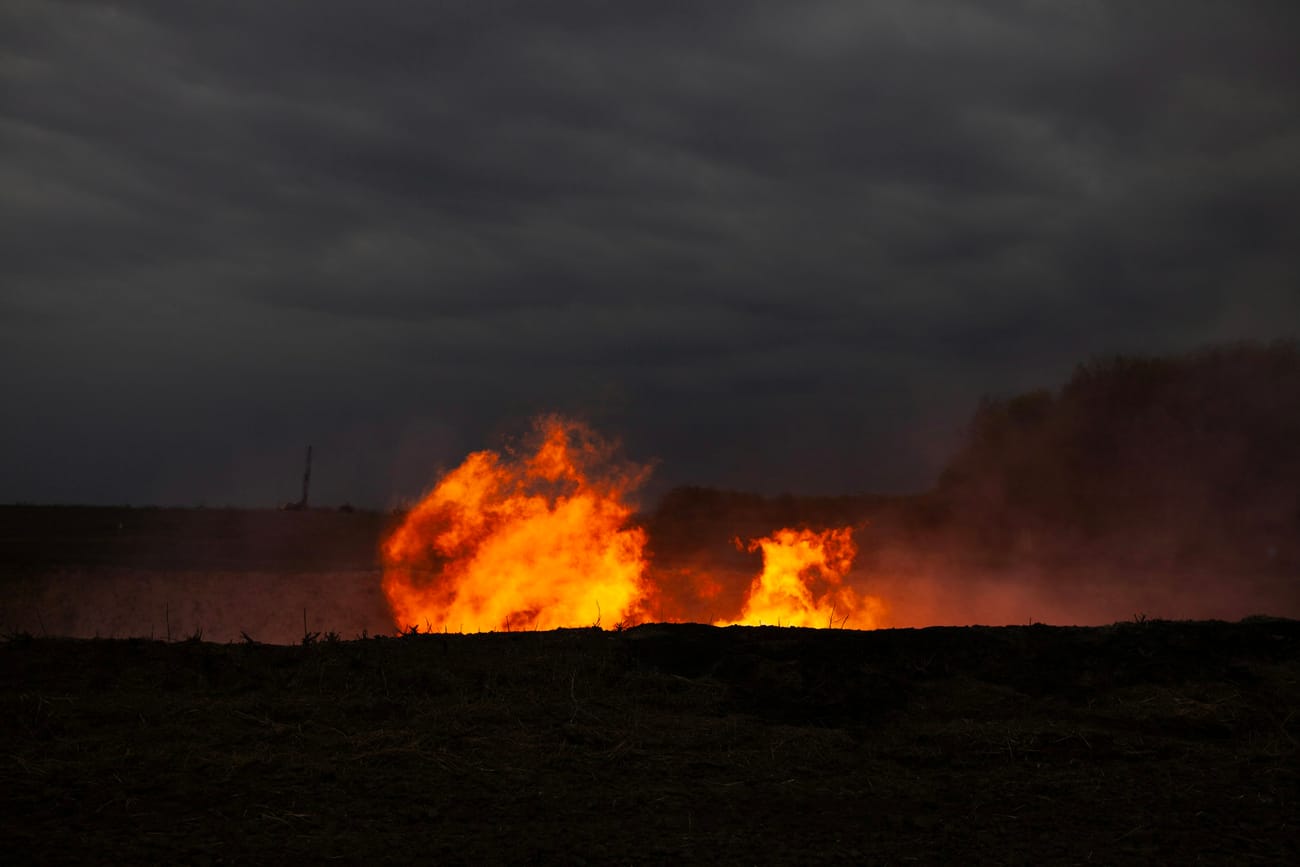

For three years, the flare at the Caprock 14 well pad in West Texas burned day and night, a column of orange visible from the highway. The gas that came up with the oil had nowhere to go: the nearest pipeline with spare capacity was eleven miles away, and the operator could not justify the connection. Last month the flare went out. The gas now feeds a generator, and the generator powers 320 bitcoin mining machines stacked in two forty-foot containers beside the tanks.
The containers belong to Emberline Digital, one of a handful of small companies buying gas from oil producers that have no other use for it. Emberline runs sites at nine well pads across the Permian and plans to reach twenty by next year.
Gas with nowhere to go
Oil wells produce associated gas along with the crude. Where pipelines exist, the gas is sold. Where they don't, or where the pipes are full, operators either shut in the well, reinject the gas or burn it in a flare. Flaring is legal within limits, but it wastes a fuel and releases carbon dioxide and some unburned methane.
"To us it's a disposal problem," says Dale Whitcomb, operations manager at Caprock Energy. "Emberline pays us a little for it. Before, it cost us a permit and a flare stack."
A mine in a shipping box
Each Emberline site is modular. A trailer-mounted gas generator of about one megawatt sits next to a gas conditioning skid that strips out liquids. The containers hold racks of mining machines, fans and a small control cabinet with a satellite link. Two technicians cover four sites from a pickup truck.
The machines run a single calculation: searching for the next valid bitcoin block. They do not care where they are, which is why they can be parked at the end of a caliche road. When a well declines, the containers move to the next one. The whole site can be packed onto trucks in two days.
The containers are loud. Fans pull desert air through the racks and push it out the far end about fifteen degrees warmer, and on a summer afternoon the machines throttle back to keep from overheating. The technicians wear ear defenders and carry spare hash boards in the truck.
The price that decides it
The economics rest on the bitcoin price and on how much computing power the rest of the network is using. At current levels, Emberline estimates that the Caprock 14 site earns about $3,100 a day in bitcoin. Its costs are the gas, which it buys at a fraction of the regional hub price, maintenance and the machines' depreciation.
Mia Castellanos, Emberline's chief executive, says the company breaks even at a bitcoin price roughly 40% below the current one. Below that, the machines at the least productive wells are switched off. "The gas is cheap, but it isn't free," she says. "When the price drops, the flare looks competitive again."
The company converts most of what it mines to dollars within a day. It holds a small reserve in bitcoin, which Castellanos calls "the part we're allowed to be wrong about".
What it does to emissions
Supporters argue that a generator burns gas more completely than a flare in a crosswind, so less methane escapes. Methane is a far more potent greenhouse gas than carbon dioxide over the first decades, so even a small improvement in combustion counts. Emberline cites measurements at three of its sites, commissioned from the environmental consultancy Clearline Methane, showing combustion efficiency above 99%.
Critics make two points. The carbon dioxide still goes into the air, now in the service of a computation rather than as waste. And a buyer for stranded gas reduces the pressure on producers and regulators to build the pipelines that would put it to other use.
A flare that pays is a flare nobody hurries to replace.
That is how Rosa Lindqvist, an energy analyst at the research group Westgate Transition, frames it. She does not dispute the combustion figures. "It is better than flaring," she says. "It is also a reason to keep producing gas where there is no pipe."
What comes next
Emberline is testing sites where the generators could feed the local grid when power prices spike and the mining machines pause. That would make the containers a flexible load, the same role some battery parks play. For now, the company's growth depends on a price set far from Texas, on screens that trade around the clock.
At Caprock 14, the generator hums at a steady pitch. The flare stack is still standing, capped, in case the containers leave.





Discussion