
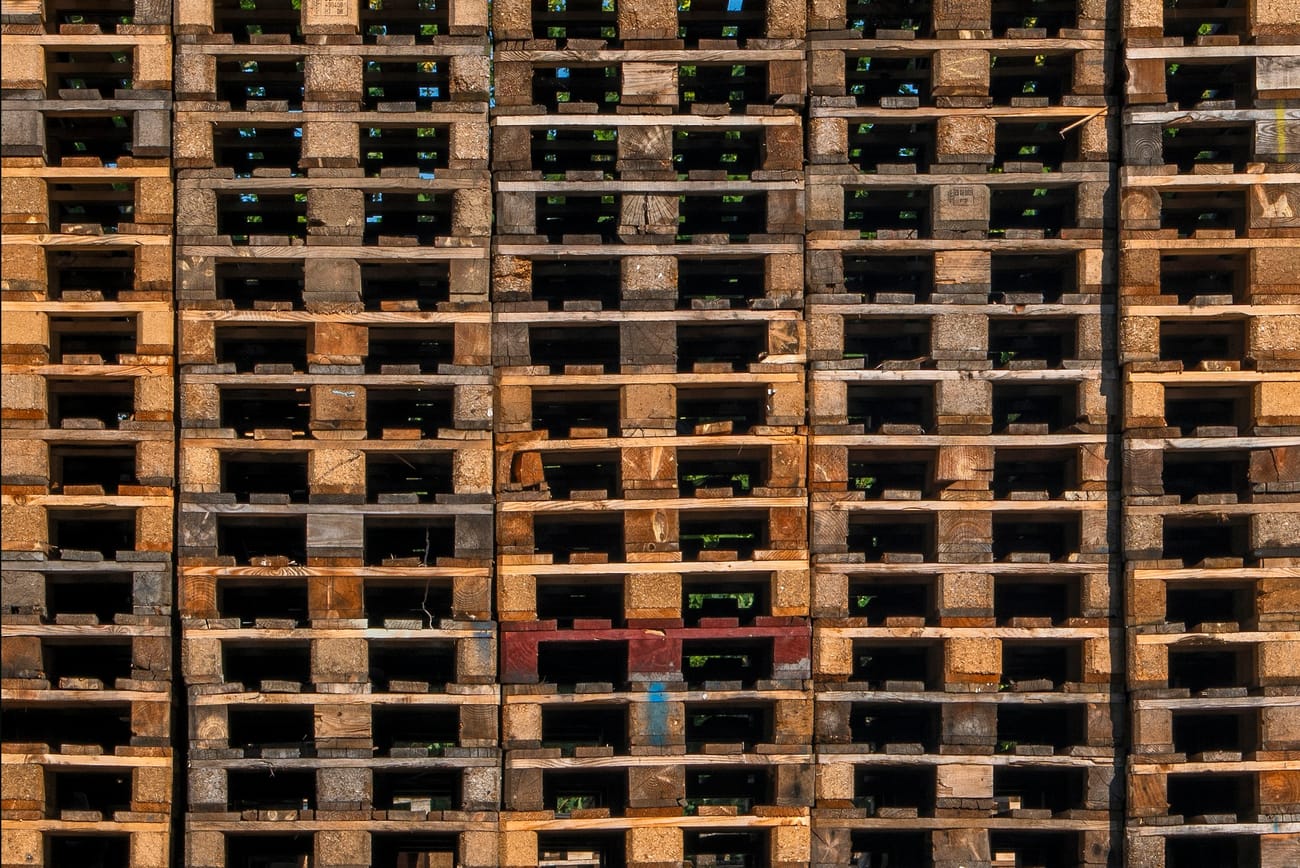

Almost everything you buy has spent part of its life on a pallet. The flat wooden platform, lifted by forklift and stacked by the thousand, is so ordinary that nobody counts it well. Our own estimate, built from the fleets that pooling companies report and the output of the larger manufacturers, puts the number in circulation worldwide at around two billion, give or take a few hundred million. Each one carries goods for a few years, breaks, gets mended and goes back to work.
Two standards, one ocean
In Europe the default is the 1,200 by 800 millimetre pallet, sized so that rows fit neatly across a standard lorry trailer. In North America it is 48 by 40 inches, about 1,219 by 1,016 millimetres. Neither sits well in the other's racking, and neither fits a shipping container perfectly: a 40-foot box takes 24 or 25 European pallets on the floor, or 20 to 21 American ones, with gaps that have to be braced.
Exporters crossing the Atlantic often ship on one standard and restack onto the other at the far end. Wilco Janssen, operations manager at a warehouse on the Maasvlakte in Rotterdam, puts the labour at about €4 a pallet. It is one reason the two systems have lasted side by side for decades.
Pools and swaps
Most pallets in Europe move in one of two ways. In an exchange system, a lorry that delivers 26 loaded pallets takes 26 empty ones back, of equivalent quality. In practice the word equivalent starts an argument at every loading dock. In a pooling system, one company owns the pallets and rents them out, collecting and repairing them between trips.
Pooled pallets are usually painted in the operator's colour so they can be found again. Exchange pallets carry a stamp on the corner blocks showing they were built to the standard. Both systems lose pallets all the time, to warehouses that keep them, to exports that never come back and to bonfires.
The repair yard
At the edge of Duisburg's inland port, Brandt Paletten runs one of the region's larger repair yards. About 14,000 used pallets arrive every day on flatbed lorries. They are sorted by hand: good ones back into stock, broken ones to the repair benches, the worst to a shredder that turns them into chips for particleboard and fuel.
Repair is quick. A worker at a bench replaces a cracked board in under a minute with a nail gun and a stack of reclaimed timber. Anke Brandt, who runs the company her grandfather started with one truck and a hammer, says a good pallet can be repaired four or five times before its blocks give out.
A pallet is a wooden promise that the next person will lift it the same way.
Brandt said it standing between stacks taller than the office roof. Her yard holds about 260,000 pallets at any one time.
The price of wood
New pallets are made from low-grade sawn softwood, the same timber that goes into fencing and crates. When builders are busy, pallet prices follow lumber up. The Break sawn-timber basket, a composite of six European softwood grades that our data desk tracks, rose about 30 per cent in the eighteen months to its last peak and has since given back half of that.
A new European pallet sold for roughly €9 before that run. At the peak, buyers paid €16 or more, and some warehouses rationed them. Repaired pallets, which Brandt sells for about two-thirds of the new price, suddenly had a waiting list.
The stamp at the border
Wooden pallets that cross borders must be heat-treated or fumigated to kill pests, and stamped to prove it. Customs and plant-health inspectors look for the mark. A shipment on unmarked wood can be refused at the port, or held until the goods are moved onto approved pallets at the importer's cost.
Plastic, paper and wood
Alternatives exist. Plastic pallets last longer and are easier to clean, which suits food and pharmaceutical plants, but they cost four to five times as much and are hard to repair. Pressed-wood and cardboard pallets serve one-way air freight. Wood keeps most of the market because it is cheap and can be fixed with a hammer.
Brandt is not worried. "Every few years someone tells me the wooden pallet is finished," she said. "Then they send me a lorry of them."





Discussion