
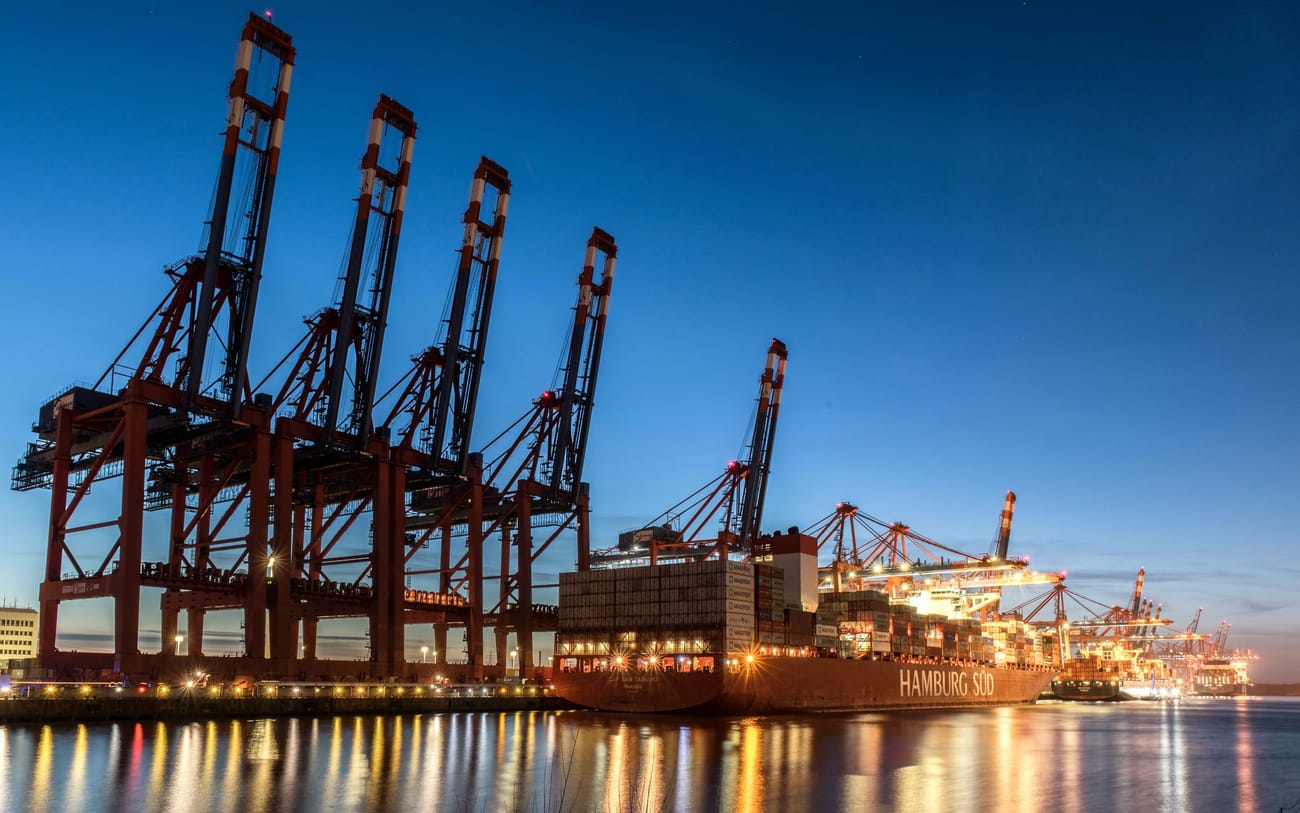

This episode of our podcast takes you forty metres above the quay at a Rotterdam container terminal, through a night shift with the people who unload the ships. You can listen with the player above; what follows is the story it tells, with some of what did not fit into the recording.
The climb
The shift at Delta Quay Terminal starts at 22:00 in a canteen smelling of coffee and diesel. The crane operators collect their radios and walk out to their machines, where a lift climbs the leg of each crane to a walkway, and a trolley carries the cab out over the ship.
Sanne de Vries, 36, has driven ship-to-shore cranes for eleven years. The cab she climbs into is the size of a lift car, with a glass floor. Between her boots is a drop of forty metres into the open hold of a ship. "The first month you look at the floor all the time," she said. "After that you stop seeing it. You only see the box."
The rhythm of a box
Each move follows the same pattern. The spreader, the steel frame that grips a container at its four corners, drops into the ship's hold. Twistlocks turn, a green light shows in the cab, and de Vries lifts. The trolley runs back over the quay and she lowers the box onto a waiting straddle carrier, or onto the lashing platform, where two men in orange vests remove the cones that locked it to the box below.
She works with two joysticks and a foot pedal. The left stick runs the trolley; the right one lifts and lowers. Speed comes with practice. Sway is what she still works on: a box on long cables swings like a pendulum, and a good operator stops the swing before it starts.
You drive the box, not the crane.
Thirty moves an hour
The terminal measures everything. A screen in the corner of the cab shows the operator's moves per hour, the ship's remaining count and the planned departure. On a good night de Vries averages 32 moves an hour. The ship she worked on our visit, a 14,000-box vessel from Asia, needed 2,300 moves across five cranes before it could sail the next evening.
"The ship does not care that it is night," said Youssef El Amrani, 51, the shift foreman, who has worked on the quay for twenty-six years. "If we are behind at four in the morning, the ship is behind at the next port, and someone there is having a bad day because of us."
Four in the morning
The hardest hour comes between three and five. Operators take a break every two hours, climbing down for tea and a sandwich. El Amrani moves people between cranes to keep them alert and counts every error that has to be fixed: a box put in the wrong stack, a spreader that has to be reset.
From the cab, the city is a line of orange lights. Out on the river, a pilot boat heads for an incoming ship. Below, the straddle carriers race between the quay and the yard with a steady whine that de Vries says she hears in her sleep.
Around four, a lasher calls up on the radio: a container in bay 18 has a bent corner casting and the twistlock will not release. De Vries holds the box a metre above the deck while two men work at it with a steel bar. It takes six minutes, which is three moves she will not get back tonight.
The quay next door
Half a kilometre away, a newer terminal runs its cranes from an office. The operators there sit at desks with screens showing camera feeds, and each can control several cranes in turn, stepping in only for the part of the move the software cannot yet do alone.
De Vries has tried it. "It is quieter and warmer, and you can have a real toilet," she said. "But you lose the feel of the wind on the box. Maybe in five years they will not need that. Tonight they still do." The same questions about skills and jobs come up in our report on the first crewless feeder crossing and in the factory that works in the dark.
Going down
At 06:00 the day shift arrives. De Vries hands over her crane with a short note on the ship's remaining count and a warning about a sticking twistlock on bay 42. Then she takes the lift down, forty metres, to solid ground. The ship will sail at 19:00 with the last box on board.





Discussion